Investigation of relationship between solid sample and
fluid media
Passage and retention capabilities of fluids and gases in
solid materials:
Key Applications
Geological and geo-technical testing
Petrology and Hydrology
Battery electrodes: electrolyte flow and active site
accessibility
Battery separators: electrolyte flow properties
Catalyst testing: accessibility to active sites
Pharmaceuticals: dissolution and disintegration
properties
Filter media: flow and retention properties
Membranes and papers: flow throughout properties
Ceramics: flow throughput and capacity properties
Sample
permeability
and
tortuosity
measurement
is
offered
as
an
extension
to
our
standard
mercury
porosimetry
analysis
options,
obtaining
porosity
and
permeability
information
in
a
single
analysis
which
provides a wealth of information in a short time-frame.
Permeability
is
a
measure
of
fluid
or
gas
flow
through
a
porous
solid
sample.
It
is,
therefore,
of
considerable
interest
in
applications
where
a
solid
material
interacts
with
a
liquid
or
gas.
Permeability
measurement
from
mercury
intrusion
analysis
was
originally
developed
with
regard
to
geological
samples, but it has since found significant application to a wide variety of sample types and sectors.
Pore
tortuosity,
obtained
from
characteristics
of
pore
size,
pore
volume,
pore
area
and
permeability
is
a
measure
of
the
tortuous
pathway
of
pores
through
a
sample:
essentially
a
representation
of
how
direct
the
pore
pathway
is
as
it
passes
through
a
sample.
This
can
be
particularly
useful
when
comparing
samples.
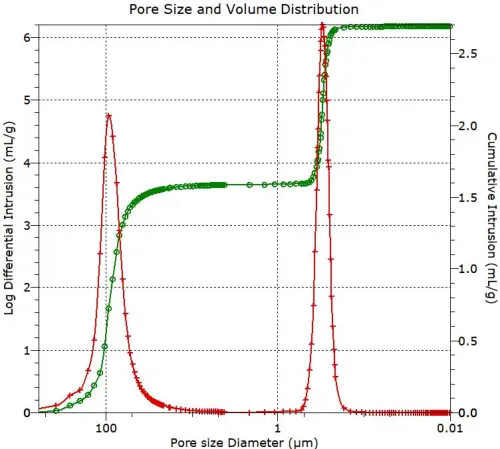
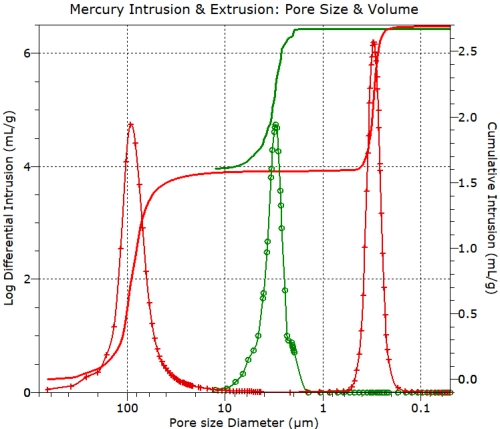
Pore volume (numerical and graphical reports)
Pore Size Distribution (numerical and graphical reports)
Pore Area (numerical and graphical reports)
Average pore size by numerous calculations
Additional calculation of bulk and skeletal density
Additional calculation of absolute porosity (% volume)
Characterisation of inter-particulate and intra-particulate
porosity
Permeability and Tortuosity measurement
Mercury intrusion and intrusion / extrusion options
Pore geometry assessment and cavity-to-throat size ratio
Assessment of particle size via Mayer-Stowe method
Extensive and flexible reporting options
Analytical Options and Highlights
Mercury
porosimetry
is
an
exceptionally
powerful
analytical
technique
for
studying
materials
with
porosity
in
the
mesopore
and
macropore
ranges.
At
MCA
Services
we
use
the
latest,
state-of-the-art
Micromeritics
AutoPore
V
instrument
to
offer
a
comprehensive
list
of
flexible
analytical
and
reporting
options.
Combined
with
our
decades
of
experience,
we
are
able
to
recommend
and
tailor
analyses
to
your
materials
and
their
performance
in
specific
applications.
We
are
also
happy
to
assist
with
data
interpretation
so
that
you
receive
the
most
pertinent
data
and
gain
the
maximum
insight
into
your
materials
and
their
efficiency.
More
information
about
mercury
porosimetry,
its
use
and
background
theory,
is
available
on
our
YouTube
channel.
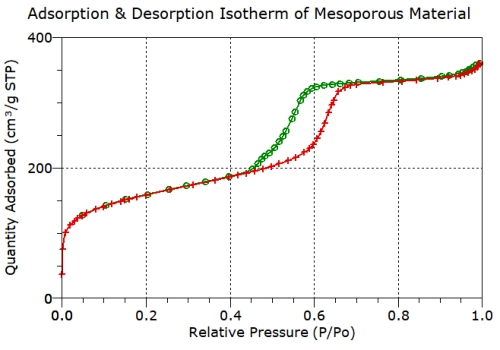
Analysis of wide range of pore sizes 3.5nm to 650 µm
Applicable to almost any solid sample form
Dissolution rate of pharmaceutical tablets and granules
Pharmaceutical powder blends and resulting solid dose
forms
Assessment of powder inter-particulate size and
volume
Ceramic raw material and finished product
characterisation
Efficiency and efficacy of filter media
Chemical activity of catalysts and electrocatalysts
Fabrication of battery electrode, separator and solid
electrolytes
Capacity and efficiency of battery electrodes and
materials
Production and performance of construction materials
Production and performance of coatings and abrasives
Characterisation of geological samples and fluid
interactions
Product life-cycle and capacity assessment
Investigations of atypical performance and failures
Key Applications
Mercury
porosimetry
provides
a
wealth
of
information
for
understanding
the
porous
characteristics
of
any
material
with
porosity
in
the
size
range
3.5
nm
to
650
µm.
The
technique
is
applicable
to
virtually
any
solid
form,
from
powders,
through
granules
to
single
solid
pieces,
films,
membranes,
fabrics
and
coatings.
The
pore
volume,
pore
area
and
pore
size
present
in
solid
materials
and
between
the
particles
of
powder
and
granules
often
profoundly
affect
the
fabrication
and
performance
of
materials.
Porosity
influences
the
efficiency,
efficacy
and
functionality
of
materials
across
sectors
such
as
pharmaceuticals,
catalysis,
energy
production
and
storage,
sorption
technology
and
geology
&
environmental
science
and
construction.
It
is
usually
necessary
to
consider
the
extent,
nature
and
effects
of
porosity
at
all
stages
of
product
life-cycle,
from
the
characterisation
of
raw
materials,
through
formulation
and
fabrication
processes
to
final
use
and
application.
Knowledge
of
the
full
porous
character
of
materials
is,
therefore,
critical to the understanding of materials and their application.
MERCURY POROSIMETRY
At
MCA
Services
sample
analysis
is
undertaken
using
our
Micromeritics
TriStar
3030
plus
and
3020
instrument,
combined
with
comprehensive
sample
degassing
options
capable
of
temperatures
in
the
range
ambient
to
400
°C
under
dynamic
vacuum
or
flowing
inert
gas.
We
can,
therefore,
prepare
virtually
any
sample
material
on-site
immediately
prior
to
analysis,
which
ensures
the
most
accurate
and
reliable
measurements are obtained.
Pore volume, area and size distributions – numerically
and graphically
Full gas adsorption and desorption isotherm
measurement
Determination of pore geometry
BET Specific Surface Area included
Assessment of microporosity via t-plot analysis and DFT /
NL-DFT
Extensive and flexible analytical and reporting options
Extensive and flexible sample degassing options
Availability of alternative adsorbents: argon and carbon
dioxide
Comprehensive range of data reduction options
BET Surface Area
BJH Mesopore volume, area and size – adsorption
isotherm
BJH Mesopore volume, area and size – desorption
isotherm
t-plot and α-S plot methods
DFT and NL-DFT
Langmuir Surface Area
Assessment of pore geometry from isotherm hysteresis
Combination with mercury porosimetry to extend pore
size range to 650 µm
Analytical Options and Highlights
The
measurement
of
the
full
gas
adsorption
and
desorption
isotherm
provides
a
full
porosimetry
analysis
technique
for
the
determination
of
pore
volume,
pore
area
and
pore
size
in
the
pore
size
range
<2
–
300
nm
diameter,
together
with
an
assessment
of
pore
geometry.
Nitrogen
is
an
ideal
adsorbate,
providing
full
chacterisation
throughout
the
mesopore
range
and
into
the
small
macropore
region.
Calculation
of
BET
surface
area
is
included
and
the
assessment
of
the
extent
and
volume
of
microporosity
can
also
be
included
through
specifically
tailored
analytical
conditions.
For
more
specialised
applications
we
also
offer alternative adsorbates such as carbon dioxide adsorption and argon adsorption.
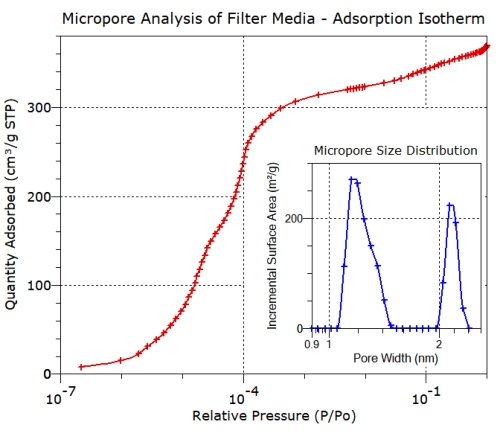
Micropores
(<
2nm
diameter)
are
common
in
a
range
of
materials,
such
as
carbons
and
nanotubes,
zeolites,
metal
organic
frameworks
(MOFs),
zeolitic
imidazolate
frameworks
(ZIFs),
covalent
organic
frameworks
(COFs)
etc.
Micropores
are
fundamentally
important
to
the
functionality
and
performance
of
many
applications,
such
as
battery
materials,
adsorbents
and
filters,
catalysts,
gas
storage
and
sequestration
materials.
Together,
micropore
volume,
area
and
size
directly
affect
performance
through
determining
capacity,
accessibility,
availability
of
active
sites
and
functionality.
Assessment
of
microporosity
can
be
derived from the same adsorption isotherm and included in reported data.
Adsorption capacity and efficacy of adsorbates and filter
media
Activity of catalysts and catalytic processes
Assessment of new, spent and regenerated catalysts and
filter media
Electrochemical activity of battery components and
constituents
Fabrication process development and control
Availability of biologically available sites in
pharmaceuticals
Inorganic, alumina and silica precursor and raw material
assessment
Behaviour of powder materials for inclusion to pastes
and emulsions
Raw material selection and QC process
Dissolution and dispersion assessment and control
Rapid assessment of microporous materials
Key Applications
The
porous
nature
of
materials
affects
a
wide
variety
of
performance
aspects
in
many
applications,
such
as
adsorption
capacity,
chemical
reactivity,
electrochemical
activity,
structural
properties
and
dissolution
rates.
Understanding
the
components
of
porosity:
pore
volume,
pore
size
and
pore
area,
is,
therefore,
critical to many sectors and applications.
Micropores,
mesopores
and
small
macropores
are
conveniently
studied
by
the
analytical
technique
of
gas
adsorption.
Gas
adsorption
provides
pore
volume,
area
and
size
data
in
the
typical
pore
size
range
2
–
300
nm,
although
the
upper
limit
depends
on
the
nature
of
the
sample.
Consideration
of
micropore
content
via
micropore
volume
and
surface
area
can
also
be
included
in
a
single
analysis.
The
latest,
powerful
and
adaptable
instrumentation
combined
with
our
decades
of
experience
means
that
we
can
recommend
the
most
suitable
analytical
options
for
your
samples.
Analyses
and
reporting
options
can
be
tailored
to
provide
the
most
pertinent
information
to
describe
your
particular
samples
and
specific
application.
We
are
also
happy
to
assist
with
data
interpretation
to
ensure
that
you
obtain
the
most
relevant
data
and
information.
GAS ADSORPTION POROSIMETRY
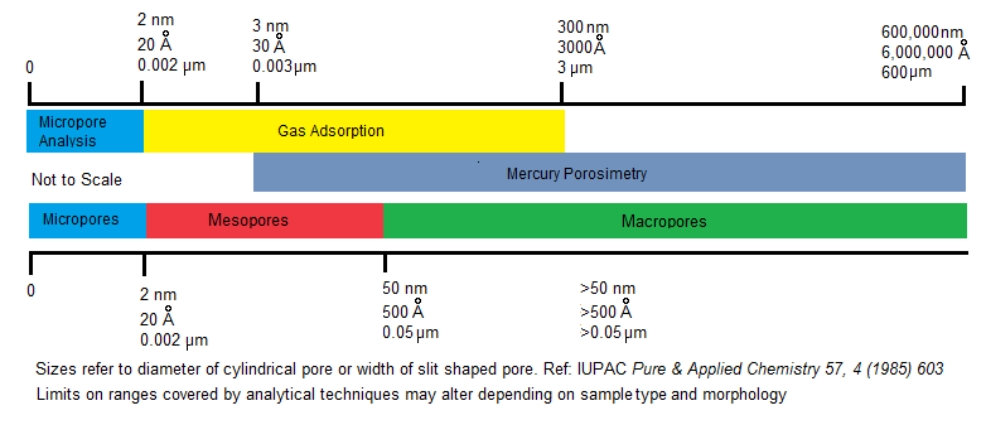
Pore
sizes
can
be
divided
into
three
ranges:
Micropores
(<
2nm),
Mesopores
(2
–
50
nm)
and
Macropores
(>
50nm),
the
sizes
refer
to
the
diameter
of
a
cylindrical
pore
or
the
width
of
a
slit-shaped
pore
according
to
IUPAC
definitions.
Micro-pores
are
sometimes
further
divided
to
include
super-micropores,
or
ultra-micropores
which
are
smaller
than
1
nm.
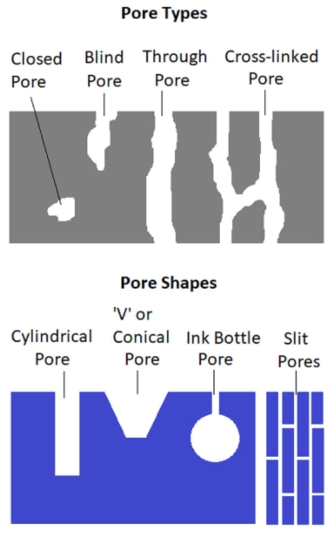
Pore
geometry,
which
includes
types
and
shapes
of
pores should also be considered.
There
is
no
single
technique
that
can
be
used
to
determine
porous
characteristics
throughout
the
ranges
of
pore
sizes.
Therefore,
it
is
usually
necessary
to
select
the
most
appropriate
technique
or
combination
of
techniques
for
a
given
sample
and
application.
At
MCA
Services
we
have
decades
of
experience
in
this
and
are
always
happy
to
provide our thoughts on this selection.
Porosimetry
covers
a
range
of
analytical
techniques
used
for
understanding
and
characterising
the
porous
nature
of
materials.
Porosity
often
has
profound
affects
on
the
behaviour
of
materials
and
influences
many
aspects of their selection, fabrication, application, performance and life-cycle.
Porosity
is
a
broad
term
which
encompasses
physical
characteristics
such
as
pore
volume,
pore
surface
area,
pore
size
distribution,
specific
surface
area,
absolute
porosity
and
pore
geometry.
It
also
has
direct
relationships
with
the
various
measures
of
sample
density,
gas
and
fluid
permeability
and
chemical
activity.
All
of
these
aspects
of
porosity
can
be
characterised
at
MCA
Services
using
a
range
of
state-of-
the-art
analytical
instruments.
Our
expertise
in
the
application
of
analyses
and
interpretation
means
that
the most pertinent data is presented and related directly to specific materials and applications.
Porosity
is
commonly
considered
as
being
present
within
a
solid
material
but
it
is
also
present
in
the
void
spaces
of
a
powder
material.
Such
inter-particulate
porosity
is
determined
by
the
particle
size
and
shape
of
the
powder
grains,
essentially
reflecting
the
packing
properties
of
powder
particles.
Understanding
inter-
particulate
porosity
becomes
very
significant
when
a
powder
is
used
in
the
fabrication
of
a
solid
article.
Combined
with
the
process
conditions,
such
as
compression,
binder
composition
and
firing
temperature
it
determines the porosity within the finished article.
POROSIMETRY
2026 MCA Services. All rights reserved






For
helium
pycnometry
analysis,
MCA
Services
has
a
range
of
sample
cells
which
allow
for
the
accurate
determination
of
absolute
density
using
samples
quantities
from
1
cm
3
to
10
cm
3
.
It
is,
therefore,
possible
to
analyse
a
wide
range
of
sample
types,
from
fine
powders
to
larger
solid
pieces.
If
the
theoretical
absolute
density
of
a
sample
material
is
known
it
is
also
possible
to
calculate
the
volume
of
closed
pores
within
the
sample
from
the
helium
pycnometry
value.
Such
calculation
is
especially
useful
when
considering
foam
and construction materials as it represents the void volume within the sample material.
Bulk
density
calculation
is
included
in
all
of
our
mercury
porosimetry
options,
which
also
provide
pore
volume,
pore
size
and
pore
area
distribution
data
in
the
pore
size
range
3.5nm
to
650µm.
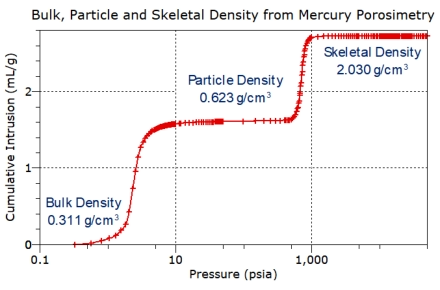
Significantly,
skeletal
density
(the
density
of
solid
material,
excluding
all
open
pores
<3.5
nm)
and
absolute
porosity
are
also
included
with
these
options.
Furthermore,
with
powder
and
granule
samples
it
is
usually
possible
to
differentiate
between
inter-particulate
and
intra-particulate
porosity,
which
allows
for
the
calculation
of
particle
density.
In
such
cases
bulk
density
represents
the
envelope
volume
of
the
entire
packed
powder
bed,
including
the
volume
of
inter-particulate
spaces
and
particle
density
measures
that
of
the
powder
grains excluding the inter-particulate volume.
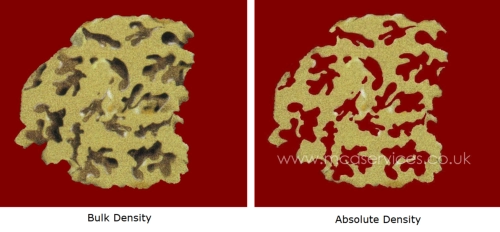
Also
termed
true
density,
excludes
the
volume
of
all
open
pores
within
the
sample
and,
therefore,
represents
the
density
of
just
the
solid
material.
The
standard
method
used
at
MCA
Services
is
gas
pycnometry
by
helium
displacement
using
our
Micromeritics
AccuPyc
instrument.
If
helium
entrapment
is
of
concern
options
for using nitrogen are also available.
Absolute Density
Also
termed
envelope
density,
includes
the
volume
of
all
pores
within
the
sample.
At
MCA
Services
this
is
measured
by
mercury
displacement
using
out
Micromeritics
AutoPore
V
instrument
and
is
available
as
a
stand-alone
analytical
option
or
as
part
of
the
more
comprehensive mercury porosimetry options.
Bulk Density
Density
is
an
important
physical
characteristic
of
solid
materials,
which
has
inextricable
links
to
porosity
and
direct
affects
the
behaviour
and
performance
of
materials.
Density
is
defined
as
the
mass
to
volume
ratio
of
a
material,
or
alternatively,
the
mass
of
a
substance
that
occupies
a
unit
volume.
Calculation
of
density
appears
straightforward:
Density
=
Mass
/
Volume.
However,
depending
on
the
precise
volume
measurement,
different
representations
of
density
can
be
calculated,
which
often
differ
in
both
their
absolute
value,
their
representation
of
the
sample
material
and
relationship
with
material
properties
and
performance.
DENSITY
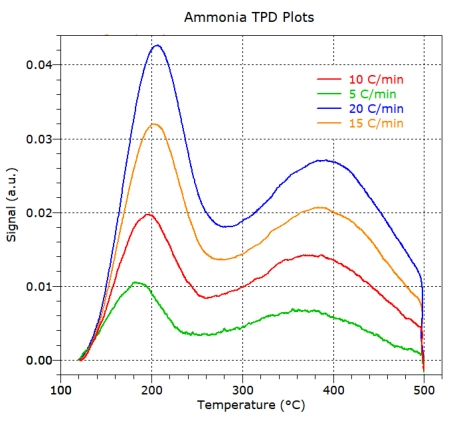
Temperature
programmed
desorption
is
used
to
study
the
temperature
dependence
and
strength
of
interaction
between
a
sample
surface
and
a
probe
molecule.
Typical
probe
molecules
include
H
2
,
CO
2
and
NH
3
,
although
others,
including
vapours,
can
also
be
applied
in
order
to
investigate
specific
systems.
Initial
adsorption,
either
physical
or
chemical,
is
usually
conducted
at
ambient
temperature,
although
sub-ambient
conditions
can
also
be
applied.
The
desorption
process
is
then
measured
with
steady
increasing sample temperature under inert gas flow.
Recording
the
temperature
at
which
desorption
occurs
and
accurately
measuring
the
volume
of
gas
desorbing
allows
for
the
determination
of
the
number
and
strength
of
active
adsorption
sites
on
a
sample
surface.
Temperature
programmed
desorption
can
also
be
extended
to
investigate
sample
materials
when
the
adsorption
/
desorption
processes
are
significant
to
performance,
for
example
effectiveness
and
regeneration
of
adsorbents,
filter
materials
and
catalysts
and
the
sorption
capacity of storage materials.
Temperature Programmed Desporption (TPD)
Our
temperature
programmed
analyses
are
part
of
our
suite
of
chemisorption
options,
used
to
investigate
reduction,
oxidation,
desorption
and
decomposition
as
a
function
of
temperature.
Traditionally
these
have
been
applied
to
the
catalysis
sector
where
the
understanding
of
surface
reactions
are
fundamental
to
the
development
and
regeneration
of
high
efficiency
systems.
The
use
of
these
techniques
is
now
commonly
extended to other sectors and applications, particularly hydrogen storage and carbon capture.
Temperature
programmed
analyses
at
MCA
Services
are
undertaken
using
our
state-of-the-art
Micromeritics
AutoChem
II
instrument,
capable
of
analyses
from
sub-ambient
(-70
°C)
to
1100
°C.
Furthermore,
this
instrument
provides
tremendous
scope
for
accurate
selection
and
control
over
analytical
parameters
such
as
gas
flow
rate,
temperature
ramp
rate
and
temperature
holding
ranges.
The
instrument
detector
is
always
calibrated
to
match
specific
analytical
parameters,
ensuring
the
accurate
calculation
of
active gas consumption.
TEMPERATURE PROGRAMMED ANALYSES
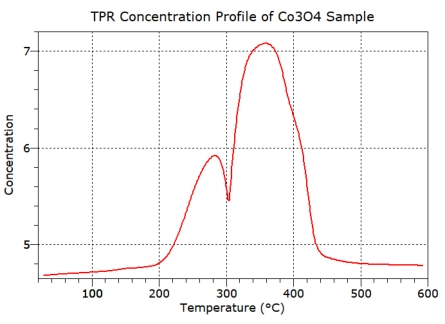
Temperature
programmed
reduction
is
used
to
investigate
the
reducibility
of
a
species
and
can
be
applied
to
metals
and
metal
compounds
such
as
oxides
in
both
supported
and
un-supported
forms.
Historically
very
important
to
the
study
of
catalysts,
TPR
can
be
applied
to
a
wide
variety
of
metallic
and
supported
metallic
species
when
reduction
behaviour
required
understanding.
The
analytical
process
involves
heating
a
sample
at
a
steady
rate,
to
a
maximum
of
1100
°C,
in
a
stream
of
reducing
gas,
typically
low
concentration
hydrogen
or
carbon
monoxide
balanced with an inert carrier.
Reduction
of
the
sample
is
then
recorded
using
a
thermal
conductivity
detector
(TCD)
as
the
concentration
of
the
reducing
gas
component
falls
as
it
is
consumed
during
reduction
of
the
sample.
At
MCA
Services,
the
TCD
is
calibrated
with
respect
to
reducing
gas
concentration
which
allows
for
the
calculation
of
active gas consumption during the reduction process.
Analogous
to
TPR,
temperature
programmed
oxidation
is
applied
to
the
study
of
oxidisable
species
on
a
material
surface.
The
analytical
process
is
very
similar
to
that
of
TPR
with
oxygen
replacing the reducing gas species in the carrier stream.
Temperature Programmed Reduction (TPR) &
Temperaure Programmed Oxidation (TPO)
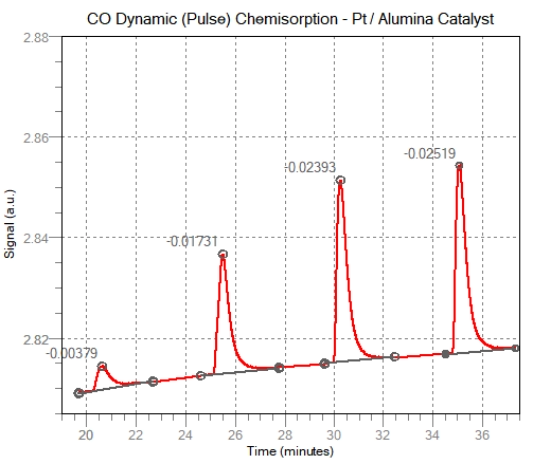
Static chemisorption analysis
Dynamic (pulse) chemisorption analysis
Wide choice of analysis temperatures
Choice of adsorbate: H
2
, CO & N
2
O
Wide choice and flexibility of pre-reduction conditions
Active species dispersion (%)
Active species surface area and total sample surface
area
Active species crystallite size
Complimentary characterisations by Temperature
Programmed Analysis
Complimentary Heat of Adsorption analysis
Analytical Options and Highlights
At
MCA
Services
we
use
a
state-of-the-art
Micromeritics
AutoChem
II
instrument
which
ensures
analyses
of
great flexibility and precision.
Dynamic,
or
pulse
chemisorption
is
undertaken
at
atmospheric
pressure
using
a
flowing
gas
stream
of
an
inert
carrier.
Successive
injections
of
a
calibrated
volume
of
the
chosen
adsorbate
gas
are
then
made
to
the
carrier
gas
and
a
Thermal
Conductivity
Detector
is
used
to
measure
the
volume
of
the
injection
not
chemically
adsorbed
to
the
sample
material.
Analysis
is
complete
when
no
further
adsorbate
is
chemically
adsorbed
to
the
sample
material.
The
total
volume
of
chemically
adsorbed
probe
molecule
can
the
be
ascertained
and
calculations
of
active
metal
dispersion,
active
metal
surface
area
and
crystallite
size
can
be made.
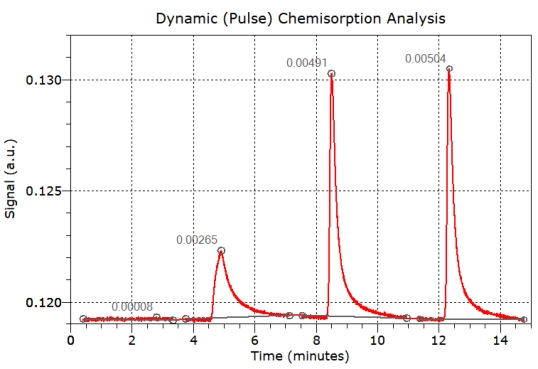
Characterisation of availability of active species
Product formulation and process control
QC control of fabrication processes
Performance determination: efficiency and capacity
Assessment of chemical activity
Determination of performance loss of time and use
Success of re-generation processes
Standard analyses using CO and H
2
probe molecules
Specialised probe molecules: N
2
O for Cu analysis
Key Applications
Chemisorption,
also
known
as
chemical
adsorption,
concerns
the
formation
of
chemical
bonds
between
an
adsorbate
species
and
the
active
surface
of
a
sample
material.
Chemisorption
is
particularly
suited
to
the
characterisation
and
optimisation
of
catalysts
but
it
can
also
be
applied
to
virtually
any
metal
containing
species
on
an
inert
support
material,
irrespective
of
its
application.
Chemisorption
analysis
provides
essential
information
on
active
metal
surface
area,
dispersion
and
crystallite
size.
Essentially,
this
can
be
used
to
determine
the
availability
of
the
active
species
which
directly
determines
efficiency,
efficacy
and
capacity.
Such
investigations
are
applicable
throughout
a
products
life-cycle,
from
the
fabrication
process
to investigating degradation during use and ultimately the success of a regeneration process.
Chemisorption
is
also
extended
to
Temperature
Programmed
Analysis:
Temperature
Programmed
Reduction, Oxidation and Desorption and also the measurement of iso-steric Heat of Adsorption.
CHEMISORPTION
Multi-point BET surface area measurement
Single-point BET surface area option available
Nitrogen and Krypton adsorption options cover virtually
any surface area
Reliable low pressure data applicable to highly micro-
porous samples
Comprehensive sample preparation and degassing
options
Highly adaptable methods to suit and match historical
data
Numerical and graphical reporting format
Analytical Options and Highlights
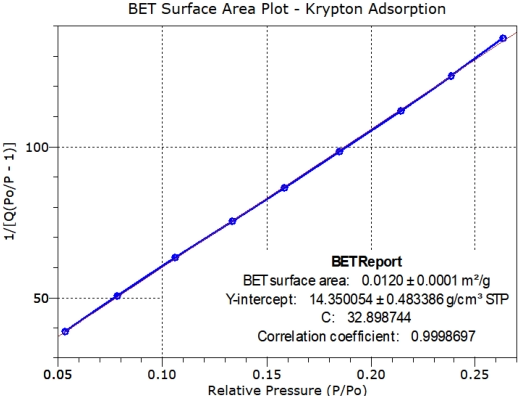
At
MCA
Services
sample
analysis
is
undertaken
using
our
Micromeritics
TriStar
3030
plus
and
3020
instruments,
which
utilise
the
volumetric
method
of
gas
adsorption.
Before
analysis
it
is
essential
that
samples
are
fully
dried
and
degassed
as
extraneous
substances
will
provide
an
artificially
low
surface
area
value.
We
have
a
comprehensive
range
of
degassing
options,
capable
of
temperatures
in
the
range
ambient
to
400
°C
under
dynamic
vacuum
or
flowing
inert
gas.
We
can,
therefore,
prepare
virtually
any
sample
material
on-site
immediately
prior
to
analysis,
which
ensures
that
the
most
accurate
and
reliable
measurements are obtained.
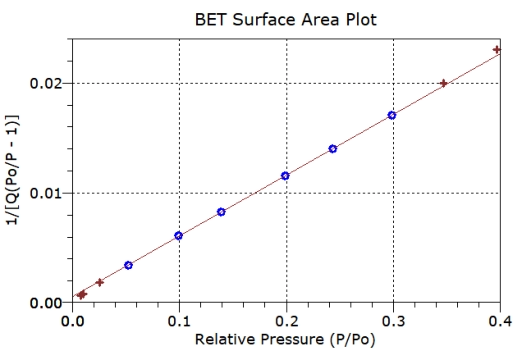
Surface area directs the interaction of a solid with other
media
Surface Area is a critical factor for:
Material selection
Processing and fabrication method development
Routine QC of raw materials and finished products
Performance assessment of products and materials
Identification of performance issues
Product capacity and life-cycle
Product regeneration
Assessment of chemical activity
Key Applications
The
surface
area
of
a
material
will
often
profoundly
affect
its
behaviour
and
performance,
whatever
its
application.
Therefore,
understanding
surface
area
is
commonly
a
critical
parameter
when
considering
materials
procurement,
processing
and
fabrication,
assessment
of
performance
and
investigation
of
atypical
performance
and
product
failure.
Specific
surface
area
can
be
used
to
directly
determine
many
factors,
such
as
reactivity,
adsorption
capacity,
dissolution
rate,
electrochemical
and
catalytic
performance
and
sintering
ability.
Specific
surface
area
is
commonly
measured
using
the
BET
(Brunauer-
Emmett-Teller)
method
applied
to
a
gas
adsorption
isotherm.
For
the
majority
of
materials
nitrogen
gas
adsorption
is
applied,
which
can
be
combined
with
the
more
extensive
full
isotherm
analysis
to
determine
pore
size
and
volume
characteristics.
However,
for
very
low
surface
area
materials
krypton
gas
adsorption
becomes
more
reliable
and
can
be
used
to
determine
surface
area
very
close
to
the
geometric
area
of
a
non-porous sample material.
The
combination
of
nitrogen
and
krypton
adsorption
methods
provides
MCA
Services
with
the
capability
of
accurately measuring materials with specific surface areas below 0.01 m
2
/g to over 2000 m
2
/g.
SPECIFIC SURFACE AREA (BET AREA)
Bulk Density, Particle Density
By Mercury Pycnometry
Absolute Density
By Helium Pycnometry
Temperature Programmed
reduction (H2, CO), Oxidation (O2),
Desorption (H2, CO2, etc)
By Temperature Programmed
Analyses
Active area, Active Dispersion,
Crystallite Site (H2, CO2, N20 for
all options)
By Dynamic Adsorption
Pore Volume, Pore Area, Pore Size
(3.5 nm- 650 um), Absolute
Porosity, Bulk Density, Skeletal
Density, Permeability, Tortuosity
By Mercury Porosimetry
Pore Volume, Pore Area, Pore Size
(<200nm), Absolute Volume (N2,
CO2, Ar, H2 for all options)
By Gas Adsorption
Multipoint BET Surface Area
By Nitrogen (>0.1m2/g) or
Krypton (<0.1m2/g) Gas
Adsorption
At
MCA
Services
we
apply
the
latest
state-of-the-art
instrumentation
to
our
materials
analysis
options.
Combined
with
decades
of
experience
in
our
analytical
techniques
across
a
wide
range
of
applications
and
sectors
you
are
assured
high
quality
analyses
and
expert
data
interpretation
with
the
most
pertinent
information
to
obtain
maximum
knowledge of your samples and their applications.
ANALYTICAL TECHNIQUES
At
MCA
Services
we
apply
the
latest
state-of-the-
art
instrumentation
to
our
materials
analysis
options.
Combined
with
decades
of
experience
in
our
analytical
techniques
across
a
wide
range
of
applications
and
sectors
you
are
assured
high
quality
analyses
and
expert
data
interpretation
with
the
most
pertinent
information
to
obtain
maximum
knowledge
of
your
samples
and
their
applications.
Bulk Density, Particle
Density
By Mercury Pycnometry
Absolute Density
By Helium Pycnometry
Temperature Programmed
reduction (H2, CO),
Oxidation (O2), Desorption
(H2, CO2, etc)
By Temperature
Programmed Analyses
Active area, Active
Dispersion, Crystallite Site
(H2, CO2, N20 for all
options)
By Dynamic Adsorption
Pore Volume, Pore Area,
Pore Size (3.5 nm- 650 um),
Absolute Porosity, Bulk
Density, Skeletal Density,
Permeability, Tortuosity
By Mercury Porosimetry
Pore Volume, Pore Area,
Pore Size (<200nm),
Absolute Volume (N2, CO2,
Ar, H2 for all options)
By Gas Adsorption
Multipoint BET Surface Area
By Nitrogen (>0.1m2/g) or
Krypton (<0.1m2/g) Gas
Adsorption
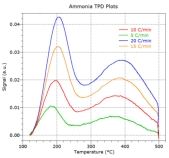
Temperature
programmed
desorption
is
used
to
study
the
temperature
dependence
and
strength
of
interaction
between
a
sample
surface
and
a
probe
molecule.
Typical
probe
molecules
include
H
2
,
CO
2
and
NH
3
,
although
others,
including
vapours,
can
also
be
applied
in
order
to
investigate
specific
systems.
Initial
adsorption,
either
physical
or
chemical,
is
usually
conducted
at
ambient
temperature,
although
sub-ambient
conditions
can
also
be
applied.
The
desorption
process
is
then
measured
with
steady
increasing
sample
temperature under inert gas flow.
Recording
the
temperature
at
which
desorption
occurs
and
accurately
measuring
the
volume
of
gas
desorbing
allows
for
the
determination
of
the
number
and
strength
of
active
adsorption
sites
on
a
sample
surface.
Temperature
programmed
desorption
can
also
be
extended
to
investigate
sample
materials
when
the
adsorption
/
desorption
processes
are
significant
to
performance,
for
example
effectiveness
and
regeneration
of
adsorbents,
filter
materials
and
catalysts
and
the
sorption
capacity of storage materials.
Temperature Programmed Desporption (TPD)
Our
temperature
programmed
analyses
are
part
of
our
suite
of
chemisorption
options,
used
to
investigate
reduction,
oxidation,
desorption
and
decomposition
as
a
function
of
temperature.
Traditionally
these
have
been
applied
to
the
catalysis
sector
where
the
understanding
of
surface
reactions
are
fundamental
to
the
development
and
regeneration
of
high
efficiency
systems.
The
use
of
these
techniques
is
now
commonly
extended
to
other
sectors
and
applications, particularly hydrogen storage and carbon capture.
Temperature
programmed
analyses
at
MCA
Services
are
undertaken
using
our
state-of-the-art
Micromeritics
AutoChem
II
instrument,
capable
of
analyses
from
sub-ambient
(-70
°C)
to
1100
°C.
Furthermore,
this
instrument
provides
tremendous
scope
for
accurate
selection
and
control
over
analytical
parameters
such
as
gas
flow
rate,
temperature
ramp
rate
and
temperature
holding
ranges.
The
instrument
detector
is
always
calibrated
to
match
specific
analytical
parameters,
ensuring
the
accurate calculation of active gas consumption.
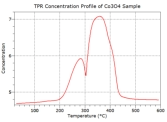
Temperature
programmed
reduction
is
used
to
investigate
the
reducibility
of
a
species
and
can
be
applied
to
metals
and
metal
compounds
such
as
oxides
in
both
supported
and
un-supported
forms.
Historically
very
important
to
the
study
of
catalysts,
TPR
can
be
applied
to
a
wide
variety
of
metallic
and
supported
metallic
species
when
reduction
behaviour
required
understanding.
The
analytical
process
involves
heating
a
sample
at
a
steady
rate,
to
a
maximum
of
1100
°C,
in
a
stream
of
reducing
gas,
typically
low
concentration
hydrogen
or
carbon
monoxide
balanced with an inert carrier.
Reduction
of
the
sample
is
then
recorded
using
a
thermal
conductivity
detector
(TCD)
as
the
concentration
of
the
reducing
gas
component
falls
as
it
is
consumed
during
reduction
of
the
sample.
At
MCA
Services,
the
TCD
is
calibrated
with
respect
to
reducing
gas
concentration
which
allows
for
the
calculation
of
active
gas
consumption
during
the
reduction process.
Analogous
to
TPR,
temperature
programmed
oxidation
is
applied
to
the
study
of
oxidisable
species
on
a
material
surface.
The
analytical
process
is
very
similar
to
that
of
TPR
with
oxygen
replacing
the
reducing
gas
species
in
the carrier stream.
Temperature Programmed Reduction (TPR) &
Temperaure Programmed Oxidation (TPO)
Static chemisorption analysis
Dynamic (pulse) chemisorption analysis
Wide choice of analysis temperatures
Choice of adsorbate: H
2
, CO & N
2
O
Wide choice and flexibility of pre-
reduction conditions
Active species dispersion (%)
Active species surface area and total
sample surface area
Active species crystallite size
Complimentary characterisations by
Temperature Programmed Analysis
Complimentary Heat of Adsorption
analysis
Analytical Options and Highlights
At
MCA
Services
we
use
a
state-of-the-art
Micromeritics
AutoChem
II
instrument which ensures analyses of great flexibility and precision.
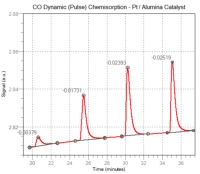
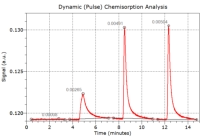
Dynamic,
or
pulse
chemisorption
is
undertaken
at
atmospheric
pressure
using
a
flowing
gas
stream
of
an
inert
carrier.
Successive
injections
of
a
calibrated
volume
of
the
chosen
adsorbate
gas
are
then
made
to
the
carrier
gas
and
a
Thermal
Conductivity
Detector
is
used
to
measure
the
volume
of
the
injection
not
chemically
adsorbed
to
the
sample
material.
Analysis
is
complete
when
no
further
adsorbate
is
chemically
adsorbed
to
the
sample
material.
The
total
volume
of
chemically
adsorbed
probe
molecule
can
the
be
ascertained
and
calculations
of
active
metal
dispersion, active metal surface area and crystallite size can be made.
Characterisation of availability of active
species
Product formulation and process control
QC control of fabrication processes
Performance determination: efficiency
and capacity
Assessment of chemical activity
Determination of performance loss of
time and use
Success of re-generation processes
Standard analyses using CO and H
2
probe
molecules
Specialised probe molecules: N
2
O for Cu
analysis
Key Applications
Chemisorption,
also
known
as
chemical
adsorption,
concerns
the
formation
of
chemical
bonds
between
an
adsorbate
species
and
the
active
surface
of
a
sample
material.
Chemisorption
is
particularly
suited
to
the
characterisation
and
optimisation
of
catalysts
but
it
can
also
be
applied
to
virtually
any
metal
containing
species
on
an
inert
support
material,
irrespective
of
its
application.
Chemisorption
analysis
provides
essential
information
on
active
metal
surface
area,
dispersion
and
crystallite
size.
Essentially,
this
can
be
used
to
determine
the
availability
of
the
active
species
which
directly
determines
efficiency,
efficacy
and
capacity.
Such
investigations
are
applicable
throughout
a
products
life-cycle,
from
the
fabrication
process
to
investigating
degradation
during
use
and
ultimately
the
success
of
a
regeneration
process.
Chemisorption
is
also
extended
to
Temperature
Programmed
Analysis:
Temperature
Programmed
Reduction,
Oxidation
and
Desorption
and
also
the measurement of iso-steric Heat of Adsorption.
TEMPERATURE PROGRAMMED ANALYSES
For
helium
pycnometry
analysis,
MCA
Services
has
a
range
of
sample
cells
which
allow
for
the
accurate
determination
of
absolute
density
using
samples
quantities
from
1
cm
3
to
10
cm
3
.
It
is,
therefore,
possible
to
analyse
a
wide
range
of
sample
types,
from
fine
powders
to
larger
solid
pieces.
If
the
theoretical
absolute
density
of
a
sample
material
is
known
it
is
also
possible
to
calculate
the
volume
of
closed
pores
within
the
sample
from
the
helium
pycnometry
value.
Such
calculation
is
especially
useful
when
considering
foam
and
construction
materials
as
it represents the void volume within the sample material.
Bulk
density
calculation
is
included
in
all
of
our
mercury
porosimetry
options,
which
also
provide
pore
volume,
pore
size
and
pore
area
distribution
data
in
the
pore
size
range
3.5nm
to
650µm.
Significantly,
skeletal
density
(the
density
of
solid
material,
excluding
all
open
pores
<3.5
nm)
and
absolute
porosity
are
also
included
with
these
options.
Furthermore,
with
powder
and
granule
samples
it
is
usually
possible
to
differentiate
between
inter-particulate
and
intra-particulate
porosity,
which
allows
for
the
calculation
of
particle
density.
In
such
cases
bulk
density
represents
the
envelope
volume
of
the
entire
packed
powder
bed,
including
the
volume
of
inter-particulate
spaces
and
particle
density
measures
that
of
the
powder
grains
excluding
the
inter-
particulate volume.
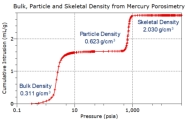

Also
termed
true
density,
excludes
the
volume
of
all
open
pores
within
the
sample
and,
therefore,
represents
the
density
of
just
the
solid
material.
The
standard
method
used
at
MCA
Services
is
gas
pycnometry
by
helium
displacement
using
our
Micromeritics
AccuPyc
instrument.
If
helium
entrapment
is
of
concern
options
for
using
nitrogen
are
also available.
Absolute Density
Also
termed
envelope
density,
includes
the
volume
of
all
pores
within
the
sample.
At
MCA
Services
this
is
measured
by
mercury
displacement
using
out
Micromeritics
AutoPore
V
instrument
and
is
available
as
a
stand-alone
analytical
option
or
as
part
of
the
more
comprehensive
mercury
porosimetry options.
Bulk Density
2026 MCA Services. All rights reserved


Investigation of relationship between solid
sample and fluid media
Passage and retention capabilities of fluids
and gases in solid materials:
Key Applications
Geological and geo-technical testing
Petrology and Hydrology
Battery electrodes: electrolyte flow and
active site accessibility
Battery separators: electrolyte flow
properties
Catalyst testing: accessibility to active
sites
Pharmaceuticals: dissolution and
disintegration properties
Filter media: flow and retention
properties
Membranes and papers: flow throughout
properties
Ceramics: flow throughput and capacity
properties
Sample
permeability
and
tortuosity
measurement
is
offered
as
an
extension
to
our
standard
mercury
porosimetry
analysis
options,
obtaining
porosity
and
permeability
information
in
a
single
analysis
which provides a wealth of information in a short timeframe.
Permeability
is
a
measure
of
fluid
or
gas
flow
through
a
porous
solid
sample.
It
is,
therefore,
of
considerable
interest
in
applications
where
a
solid
material
interacts
with
a
liquid
or
gas.
Permeability
measurement
from
mercury
intrusion
analysis
was
originally
developed
with
regard
to
geological
samples,
but
it
has
since
found
significant
application
to
a
wide variety of sample types and sectors.
Pore
tortuosity,
obtained
from
characteristics
of
pore
size,
pore
volume,
pore
area
and
permeability
is
a
measure
of
the
tortuous
pathway
of
pores
through
a
sample:
essentially
a
representation
of
how
direct
the
pore
pathway
is
as
it
passes
through
a
sample.
This
can
be
particularly
useful when comparing samples.
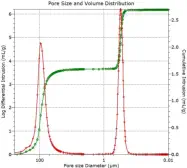
Pore volume (numerical and graphical
reports)
Pore Size Distribution (numerical and
graphical reports)
Pore Area (numerical and graphical reports)
Average pore size by numerous calculations
Additional calculation of bulk and skeletal
density
Additional calculation of absolute porosity
(% volume)
Characterisation of inter-particulate and
intra-particulate porosity
Permeability and Tortuosity measurement
Mercury intrusion and intrusion / extrusion
options
Pore geometry assessment and cavity-to-
throat size ratio
Assessment of particle size via Mayer-Stowe
method
Extensive and flexible reporting options
Analytical Options and Highlights
Mercury
porosimetry
is
an
exceptionally
powerful
analytical
technique
for
studying
materials
with
porosity
in
the
mesopore
and
macropore
ranges.
At
MCA
Services
we
use
the
latest,
state-of-the-art
Micromeritics
AutoPore
V
instrument
to
offer
a
comprehensive
list
of
flexible
analytical
and
reporting
options.
Combined
with
our
decades
of
experience,
we
are
able
to
recommend
and
tailor
analyses
to
your
materials
and
their
performance
in
specific
applications.
We
are
also
happy
to
assist
with
data
interpretation
so
that
you
receive
the
most
pertinent
data
and
gain
the
maximum
insight
into
your
materials
and
their
efficiency.
More
information
about
mercury
porosimetry,
its
use
and background theory, is available on our YouTube channel.
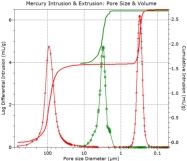
Analysis of wide range of pore sizes 3.5nm to
650 µm
Applicable to almost any solid sample form
Dissolution rate of pharmaceutical tablets
and granules
Pharmaceutical powder blends and resulting
solid dose forms
Assessment of powder inter-particulate size
and volume
Ceramic raw material and finished product
characterisation
Efficiency and efficacy of filter media
Chemical activity of catalysts and
electrocatalysts
Fabrication of battery electrode, separator
and solid electrolytes
Capacity and efficiency of battery electrodes
and materials
Production and performance of construction
materials
Production and performance of coatings and
abrasives
Characterisation of geological samples and
fluid interactions
Product life-cycle and capacity assessment
Investigations of atypical performance and
failures
Key Applications
Mercury
porosimetry
provides
a
wealth
of
information
for
understanding
the
porous
characteristics
of
any
material
with
porosity
in
the
size
range
3.5
nm
to
650
µm.
The
technique
is
applicable
to
virtually
any
solid
form,
from
powders,
through
granules
to
single
solid
pieces,
films,
membranes,
fabrics
and
coatings.
The
pore
volume,
pore
area
and
pore
size
present
in
solid
materials
and
between
the
particles
of
powder
and
granules
often
profoundly
affect
the
fabrication
and
performance
of
materials.
Porosity
influences
the
efficiency,
efficacy
and
functionality
of
materials
across
sectors
such
as
pharmaceuticals,
catalysis,
energy
production
and
storage,
sorption
technology
and
geology
&
environmental
science
and
construction.
It
is
usually
necessary
to
consider
the
extent,
nature
and
effects
of
porosity
at
all
stages
of
product
life-cycle,
from
the
characterisation
of
raw
materials,
through
formulation
and
fabrication
processes
to
final
use
and
application.
Knowledge
of
the
full
porous
character
of
materials
is,
therefore,
critical
to
the
understanding
of
materials
and
their
application.
At
MCA
Services
sample
analysis
is
undertaken
using
our
Micromeritics
TriStar
3030
plus
and
3020
instrument,
combined
with
comprehensive
sample
degassing
options
capable
of
temperatures
in
the
range
ambient
to
400
°C
under
dynamic
vacuum
or
flowing
inert
gas.
We
can,
therefore,
prepare
virtually
any
sample
material
on-site
immediately
prior
to
analysis,
which
ensures
the
most
accurate
and
reliable
measurements are obtained.
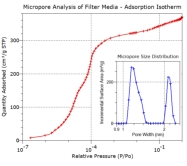
Pore volume, area and size distributions –
numerically and graphically
Full gas adsorption and desorption isotherm
measurement
Determination of pore geometry
BET Specific Surface Area included
Assessment of microporosity via t-plot
analysis and DFT / NL-DFT
Extensive and flexible analytical and
reporting options
Extensive and flexible sample degassing
options
Availability of alternative adsorbents: argon
and carbon dioxide
Comprehensive range of data reduction
options
BET Surface Area
BJH Mesopore volume, area and size –
adsorption isotherm
BJH Mesopore volume, area and size –
desorption isotherm
t-plot and α-S plot methods
DFT and NL-DFT
Langmuir Surface Area
Assessment of pore geometry from isotherm
hysteresis
Combination with mercury porosimetry to
extend pore size range to 650 µm
Analytical Options and Highlights
The
measurement
of
the
full
gas
adsorption
and
desorption
isotherm
provides
a
full
porosimetry
analysis
technique
for
the
determination
of
pore
volume,
pore
area
and
pore
size
in
the
pore
size
range
<2
–
300
nm
diameter,
together
with
an
assessment
of
pore
geometry.
Nitrogen
is
an
ideal
adsorbate,
providing
full
chacterisation
throughout
the
mesopore
range
and
into
the
small
macropore
region.
Calculation
of
BET
surface
area
is
included
and
the
assessment
of
the
extent
and
volume
of
microporosity
can
also
be
included
through
specifically
tailored
analytical
conditions.
For
more
specialised
applications
we
also
offer
alternative
adsorbates
such
as
carbon
dioxide
adsorption
and
argon
adsorption.
Micropores
(<
2nm
diameter)
are
common
in
a
range
of
materials,
such
as
carbons
and
nanotubes,
zeolites,
metal
organic
frameworks
(MOFs),
zeolitic
imidazolate
frameworks
(ZIFs),
covalent
organic
frameworks
(COFs)
etc.
Micropores
are
fundamentally
important
to
the
functionality
and
performance
of
many
applications,
such
as
battery
materials,
adsorbents
and
filters,
catalysts,
gas
storage
and
sequestration
materials.
Together,
micropore
volume,
area
and
size
directly
affect
performance
through
determining
capacity,
accessibility,
availability
of
active
sites
and
functionality.
Assessment
of
microporosity
can
be
derived
from
the
same
adsorption
isotherm
and
included
in
reported
data.
Adsorption capacity and efficacy of
adsorbates and filter media
Activity of catalysts and catalytic processes
Assessment of new, spent and regenerated
catalysts and filter media
Electrochemical activity of battery
components and constituents
Fabrication process development and
control
Availability of biologically available sites in
pharmaceuticals
Inorganic, alumina and silica precursor and
raw material assessment
Behaviour of powder materials for inclusion
to pastes and emulsions
Raw material selection and QC process
Dissolution and dispersion assessment and
control
Rapid assessment of microporous materials
Key Applications
The
porous
nature
of
materials
affects
a
wide
variety
of
performance
aspects
in
many
applications,
such
as
adsorption
capacity,
chemical
reactivity,
electrochemical
activity,
structural
properties
and
dissolution
rates.
Understanding
the
components
of
porosity:
pore
volume,
pore
size
and
pore
area,
is,
therefore,
critical
to
many
sectors
and
applications.
Micropores,
mesopores
and
small
macropores
are
conveniently
studied
by
the
analytical
technique
of
gas
adsorption.
Gas
adsorption
provides
pore
volume,
area
and
size
data
in
the
typical
pore
size
range
2
–
300
nm,
although
the
upper
limit
depends
on
the
nature
of
the
sample.
Consideration
of
micropore
content
via
micropore
volume
and
surface
area
can
also
be
included
in
a
single
analysis.
The
latest,
powerful
and
adaptable
instrumentation
combined
with
our
decades
of
experience
means
that
we
can
recommend
the
most
suitable
analytical
options
for
your
samples.
Analyses
and
reporting
options
can
be
tailored
to
provide
the
most
pertinent
information
to
describe
your
particular
samples
and
specific
application.
We
are
also
happy
to
assist
with
data
interpretation
to
ensure
that
you
obtain
the
most
relevant
data
and
information.
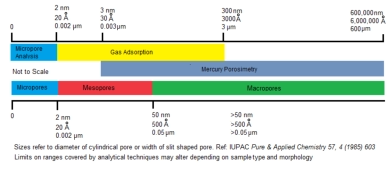
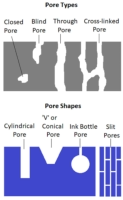
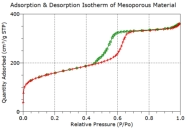
Pore
sizes
can
be
divided
into
three
ranges:
Micropores
(<
2nm),
Mesopores
(2
–
50
nm)
and
Macropores
(>
50nm),
the
sizes
refer
to
the
diameter
of
a
cylindrical
pore
or
the
width
of
a
slit-shaped
pore
according
to
IUPAC
definitions.
Micro-pores
are
sometimes
further
divided
to
include
super-micropores,
or
ultra-
micropores
which
are
smaller
than
1
nm.
Pore
geometry,
which
includes
types
and
shapes
of
pores
should
also
be considered.
There
is
no
single
technique
that
can
be
used
to
determine
porous
characteristics
throughout
the
ranges
of
pore
sizes.
Therefore,
it
is
usually
necessary
to
select
the
most
appropriate
technique
or
combination
of
techniques
for
a
given
sample
and
application.
At
MCA
Services
we
have
decades
of
experience
in
this
and
are
always happy to provide our thoughts on this selection.
Porosimetry
covers
a
range
of
analytical
techniques
used
for
understanding
and
characterising
the
porous
nature
of
materials.
Porosity
often
has
profound
affects
on
the
behaviour
of
materials
and
influences
many
aspects
of
their
selection,
fabrication,
application,
performance and life-cycle.
Porosity
is
a
broad
term
which
encompasses
physical
characteristics
such
as
pore
volume,
pore
surface
area,
pore
size
distribution,
specific
surface
area,
absolute
porosity
and
pore
geometry.
It
also
has
direct
relationships
with
the
various
measures
of
sample
density,
gas
and
fluid
permeability
and
chemical
activity.
All
of
these
aspects
of
porosity
can
be
characterised
at
MCA
Services
using
a
range
of
state-of-the-art
analytical
instruments.
Our
expertise
in
the
application
of
analyses
and
interpretation
means
that
the
most
pertinent
data
is
presented
and
related directly to specific materials and applications.
Porosity
is
commonly
considered
as
being
present
within
a
solid
material
but
it
is
also
present
in
the
void
spaces
of
a
powder
material.
Such
inter-particulate
porosity
is
determined
by
the
particle
size
and
shape
of
the
powder
grains,
essentially
reflecting
the
packing
properties
of
powder
particles.
Understanding
inter-particulate
porosity
becomes
very
significant
when
a
powder
is
used
in
the
fabrication
of
a
solid
article.
Combined
with
the
process
conditions,
such
as
compression,
binder
composition
and
firing
temperature
it
determines
the porosity within the finished article.
GAS ADSORPTION
MERCURY POROSIMETRY
Density
is
an
important
physical
characteristic
of
solid
materials,
which
has
inextricable
links
to
porosity
and
direct
affects
the
behaviour
and
performance
of
materials.
Density
is
defined
as
the
mass
to
volume
ratio
of
a
material,
or
alternatively,
the
mass
of
a
substance
that
occupies
a
unit
volume.
Calculation
of
density
appears
straightforward:
Density
=
Mass
/
Volume.
However,
depending
on
the
precise
volume
measurement,
different
representations
of
density
can
be
calculated,
which
often
differ
in
both
their
absolute
value,
their
representation
of
the
sample
material
and
relationship
with
material
properties
and
performance.
Multi-point BET surface area measurement
Single-point BET surface area option
available
Nitrogen and Krypton adsorption options
cover virtually any surface area
Reliable low pressure data applicable to
highly micro-porous samples
Comprehensive sample preparation and
degassing options
Highly adaptable methods to suit and
match historical data
Numerical and graphical reporting format
Analytical Options and Highlights
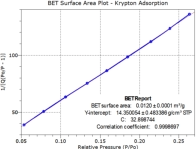
At
MCA
Services
sample
analysis
is
undertaken
using
our
Micromeritics
TriStar
3030
plus
and
3020
instruments,
which
utilise
the
volumetric
method
of
gas
adsorption.
Before
analysis
it
is
essential
that
samples
are
fully
dried
and
degassed
as
extraneous
substances
will
provide
an
artificially
low
surface
area
value.
We
have
a
comprehensive
range
of
degassing
options,
capable
of
temperatures
in
the
range
ambient
to
400
°C
under
dynamic
vacuum
or
flowing
inert
gas.
We
can,
therefore,
prepare
virtually
any
sample
material
on-site
immediately
prior
to
analysis,
which
ensures
that
the
most
accurate
and
reliable
measurements are obtained.
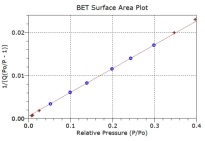
Surface area directs the interaction of a
solid with other media
Surface Area is a critical factor for:
Material selection
Processing and fabrication method
development
Routine QC of raw materials and
finished products
Performance assessment of products
and materials
Identification of performance issues
Product capacity and life-cycle
Product regeneration
Assessment of chemical activity
Key Applications
The
surface
area
of
a
material
will
often
profoundly
affect
its
behaviour
and
performance,
whatever
its
application.
Therefore,
understanding
surface
area
is
commonly
a
critical
parameter
when
considering
materials
procurement,
processing
and
fabrication,
assessment
of
performance
and
investigation
of
atypical
performance
and
product
failure.
Specific
surface
area
can
be
used
to
directly
determine
many
factors,
such
as
reactivity,
adsorption
capacity,
dissolution
rate,
electrochemical
and
catalytic
performance
and
sintering
ability.
Specific
surface
area
is
commonly
measured
using
the
BET
(Brunauer-
Emmett-Teller)
method
applied
to
a
gas
adsorption
isotherm.
For
the
majority
of
materials
nitrogen
gas
adsorption
is
applied,
which
can
be
combined
with
the
more
extensive
full
isotherm
analysis
to
determine
pore
size
and
volume
characteristics.
However,
for
very
low
surface
area
materials
krypton
gas
adsorption
becomes
more
reliable
and
can
be
used
to
determine
surface
area
very
close
to
the
geometric
area
of
a
non-porous sample material.
The
combination
of
nitrogen
and
krypton
adsorption
methods
provides
MCA
Services
with
the
capability
of
accurately
measuring
materials
with specific surface areas below 0.01 m
2
/g to over 2000 m
2
/g.